
— English version below —
Comme je l’ai expliqué dans l’article sur mon plus ancien ancêtre Zimpfer retrouvé, la zone d’origine se situe aux alentours de Helmlingen / Lichtenau, dans le Baden-Württemberg (à l’époque, le Comté de Hanau-Lichtenberg).
Pour ma part, je suis né en Alsace, à Haguenau, et j’ai passé les 25 premières années de ma vie à Bischwiller, ou sont nés mes deux parents, et ou habitaient aussi mes grands-parents.
Mon grand-père paternel, Alfred Zimpfer (1907-1968) est, quand à lui, né à Oberhoffen-sur-Moder (un village à côté de Bischwiller), tout comme son père Karl Zimpfer (1873-1949), son grand-père Christian Zimpfer (1838-1905) et son arrière-grand-père Chrétien George Zuimpfer (1813-1860).
Je me suis donc mis en quête du premier Zimpfer qui est venu s’installer à Oberhoffen-sur-Moder, depuis Helmlingen (qui ne sont distantes que d’une quinzaine de kilomètres à vol d’oiseau) et il s’agit d’Andreas Zimpfer, né vers 1758 à Helmligen, et décédé le 27 Octobre 1833 à Oberhoffen-sur-Moder.
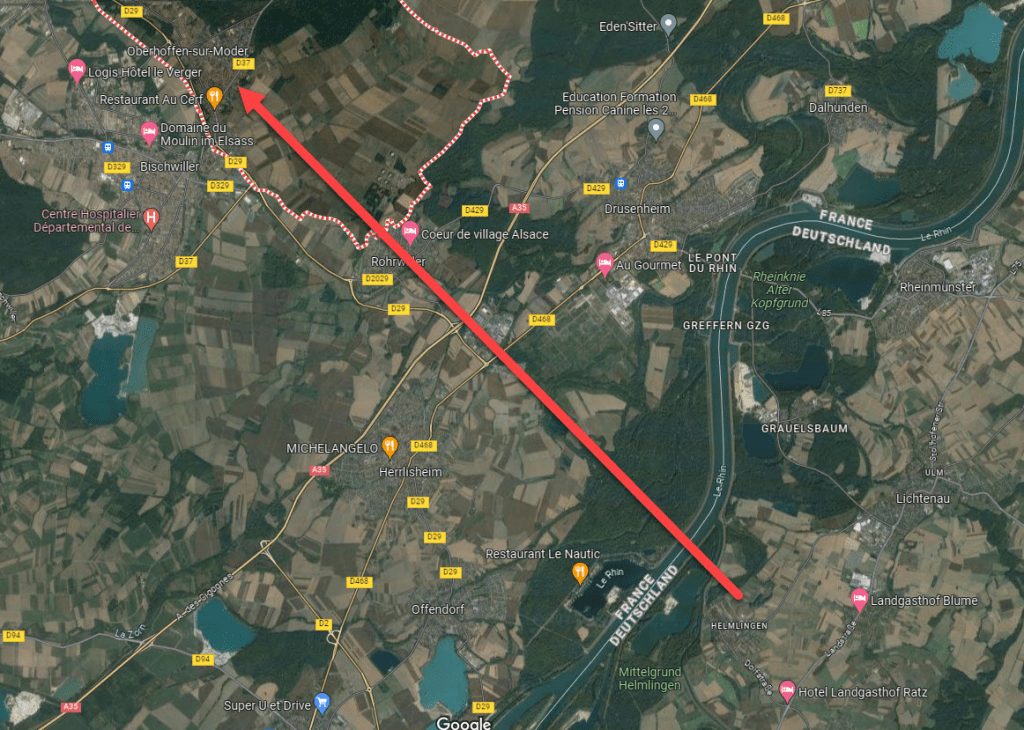
Je n’ai aucune certitude sur les raisons de cette installation à Oberhoffen, mais peut-être que l’amour y a jouer un rôle (du moins, c’est que je me plais à imaginer). En effet, le 14 mai 1787, Andreas a épousé, à Oberhoffen-sur-Moder, Marie-Barbe Liess (1766-1816) née et donc originaire d’Oberhoffen.
Je me suis même amusé à lui rédiger une biographie romancée…
Biographie romancée :
Andreas ZIMPFER est né en 1758, à Helmlingen, de Andreas ZIMPFER (1740-1770) et Christine SCHOCH. Il est l’aîné d’une fratrie d’au moins trois enfants, avec son frère Johann Michael, né en 1764, et Jacob né en 1770. Ils seront orphelins de père très tôt, puisqu’Andreas père meurt le 13 Septembre 1770, à l’âge d’à peine trente ans.
Très jeune, le petit Andreas s’intéressa à la musique, à cause d’une petite flûte en bois que lui avait sculptée et offert l’un de ses oncles. Il pouvait passer des heures à apprendre à en jouer, au grand dam de son père, qui souhaitait l’initier le plus tôt possible à son métier de tisserand. Au décès de son père, étant l’aîné de la famille, il n’eut pas d’autre solution que d’aider sa mère à tisser, ne consacrant alors plus que très peu de temps à la pratique de la flûte. Son plus grand rêve est d’aller, lorsqu’il sera plus grand, participer au « Pfiffersdaa ».
En 1687, le roi Louis XIV accorda à Christian II, Prince de Deux-Pont-Birkenfled-Bischwiller, le droit de faire tenir, le 15 Août à Bischwiller une foire annuelle (Pfeifertag / Pfiffersdaa) à l’occasion de la réunion des musiciens (ménétriers) de la Basse Alsace. Et depuis ce jour, Bischwiller est le théâtre, à la mi-Août, du plus grand rassemblement de fifres, musiciens et saltimbanques de toute la région.
Finalement, le 14 Aout 1786, il franchit le pas, et se rendit à Bischwiller avec sa flûte et un petit baluchon avec quelques affaires, et de quoi manger sur le trajet. Il y avait moins de vingt kilomètres à parcourir, mais un fleuve à traverser : le Rhin. La traversée se fit sans encombre, et Andreas fini par arriver à Bischwiller. Il avait rendez-vous avec un ami à l’Auberge du Lion d’Or, qui leur avait réservé l’une de leurs rares chambres pour deux jours. Et fort heureusement. Car il y avait déjà un monde fou.
Le matin du 15 Août 1786, tous les fifres et ménétriers avaient rendez-vous devant la Laub sur la place sur laquelle se tenait le marché associé. Andreas ne savait plus où donner de la tête. Il y avait plus de 1000 personnes présentes, entre les musiciens, les marchands, et les spectateurs. Il y avait beaucoup de fifres, mais aussi des trompettes, des flûtes, des hautbois, des clarinettes, et quelques violons ou luths. Et tous attendaient la même personne, leur représentant, le « Roi des fifres », afin de se rendre, sous sa houlette, en cortège, vers l’Eglise Saint-Nicolas de Hanhoffen.
A neuf heures, ce dernier apparu, sortant de la Laub, et montant sur une petite estrade dressée en son honneur devant le bâtiment. Il fit signe aux trompettistes qui avaient pris place à droite et à gauche de l’estrade de jouer, afin d’obtenir le silence sur la place. Puis il prit la parole, pour son traditionnel discours d’ouverture du Pfiffersdaa, ou il ne manqua pas de saluer également les confréries de Ménétrier de Ribeauvillé, en plus de toutes les confréries de la Basse Alsace.
Puis un long cortège désordonné se forma, le Roi des Fifres en tête, pour se rendre à Hanhoffen, à quelques kilomètres de là, en l’Eglise Saint-Nicolas, pour la traditionnelle célébration religieuse de la fête des fifres. Andreas se fraya un passage à travers la foule, pour essayer de retrouver son ami, qu’il avait perdu de vue quelques minutes auparavant. Il y avait tellement de monde ! Soudain, alors qu’il regardait sur sa gauche, croyant l’avoir aperçu, il percuta une personne devant lui. Se retournant, pour s’excuser, il se retrouva nez-à-nez avec une charmante jeune femme, qui le regardait avec un grand sourire. Immédiatement il tomba sous le charme et resta bouche bée, n’arrivant même plus à s’excuser.
Il venait de rencontre une jeune demoiselle du patelin voisin, Oberhoffen-sur-Moder, Maria Barbara LIESS, et ce fut le coup de foudre, réciproque. La jeune femme fit tout son possible pour passer le plus de temps possible avec Andreas, sans forcément éveiller les soupçons de Théobald, son père. Mais ce dernier n’était pas dupe. Il avait bien remarqué leur petit manège, les sourires échanges, les chuchotements à l’Eglise, mais il lassa faire. Le jeune homme semblait être un bon parti pour sa fille : il avait de beaux habits propres, un métier (tisserand), et semblait honnête.
La journée s’acheva par une espèce de banquet à l’Auberge du Lion d’Or, ou malheureusement Maria Barbara ne prit pas part. Elle et son père étaient rentrés sur Oberhoffen. Mais elle lui avait promis qu’elle reviendrait le voir le lendemain, avant se départ pour Helmlingen. Et la promesse fut tenue. Le couple échangea un baiser discret, et une promesse -celle de se revoir très bientôt- avant qu’Andreas ne reprenne le chemin pour Helmlingen. Il rentra avant la nuit, la tête pleine de souvenir du Pfifersdaa, et surtout, de Maria Barbara.
Quelques semaines plus tard, Andreas retrouva sa belle, à Oberhoffen cette fois-ci, et quelques mois plus tard, le couple se maria, le 14 Mai 1787, à Oberhoffen-sur-Moder. De cette union naquirent au moins cinq enfants : Dorothea née en 1787, Maria Elisabeth née en 1790, Jacob né en 1792, Johan Michael né en 1794 et Andreas né en 1797. Andreas est le premier des « Zimpfer » à quitter la région d’Helmlingen, et surtout le premier à s’installer en Alsace (ou du moins ce qui sera l’Alsace par la suite).
Lien vers sa page sur mon site : Andreas ZIMPFER (1758-1833)
Pour vous inscrire sur mon site, je vous invite à visiter l’Article suivant : Mon Site Généalogique
As I explained in the article on my earliest Zimpfer ancestor, the area of origin is around Helmlingen / Lichtenau, in Baden-Württemberg (then the County of Hanau-Lichtenberg).
I was born in Alsace, in Haguenau, and spent the first 25 years of my life in Bischwiller, where both my parents were born, and where my grandparents also lived.
My paternal grandfather, Alfred Zimpfer (1907-1968), was born in Oberhoffen-sur-Moder (a village near Bischwiller), as were his father Karl Zimpfer (1873-1949), his grandfather Christian Zimpfer (1838-1905) and his great-grandfather Chrétien George Zuimpfer (1813-1860).
I therefore set out to find the first Zimpfer to settle in Oberhoffen-sur-Moder, from Helmlingen (which is only fifteen kilometres away as the crow flies). He was Andreas Zimpfer, born around 1758 in Helmligen, and died on 27 October 1833 in Oberhoffen-sur-Moder.
I’m not sure why Andreas moved to Oberhoffen, but perhaps love played a part (or so I like to think). On 14 May 1787, Andreas married Marie-Barbe Liess (1766-1816) in Oberhoffen-sur-Moder, who was born in Oberhoffen.
I even had some fun writing a fictional biography of her…
Fictional biography :
Andreas ZIMPFER was born in Helmlingen in 1758 to Andreas ZIMPFER (1740-1770) and Christine SCHOCH. He was the eldest of at least three children, along with his brother Johann Michael, born in 1764, and Jacob, born in 1770. Andreas’s father died on 13 September 1770, aged just thirty.
From a very early age, little Andreas became interested in music, thanks to a small wooden flute carved and given to him by one of his uncles. He could spend hours learning to play it, much to the annoyance of his father, who wanted to introduce him to his trade as a weaver as soon as possible. When his father died, being the eldest in the family, he had no choice but to help his mother weave, devoting very little time to playing the flute. His greatest dream was to take part in the « Pfiffersdaa » when he grew up.
In 1687, King Louis XIV granted Christian II, Prince of Deux-Pont-Birkenfled-Bischwiller, the right to hold an annual fair (Pfeifertag / Pfiffersdaa) in Bischwiller on 15 August to mark the meeting of the musicians (minstrels) of Lower Alsace. Since then, in mid-August, Bischwiller has been the scene of the largest gathering of fifes, musicians and acrobats in the whole region.
Finally, on 14 August 1786, he took the plunge and set off for Bischwiller with his flute and a small bundle containing a few belongings and something to eat on the way. There were less than twenty kilometres to cover, but a river to cross: the Rhine. The crossing went smoothly, and Andreas eventually arrived in Bischwiller. He was meeting a friend at the Auberge du Lion d’Or, who had booked one of their rare rooms for them for two days. And fortunately so. Because the place was already packed.
On the morning of 15 August 1786, all the fife players and minstrels met in front of the Laub on the square where the associated market was held. Andreas didn’t know which way to turn. There were over 1,000 people present, including musicians, merchants and spectators. There were lots of fifes, but also trumpets, flutes, oboes, clarinets and a few violins and lutes. And they were all waiting for the same person, their representative, the « King of the fifes », to lead them in a procession to the Church of Saint-Nicolas in Hanhoffen.
At nine o’clock, the latter appeared, coming out of the Laub and climbing onto a small platform set up in his honour in front of the building. He signalled to the trumpeters who had taken their places to the right and left of the platform to play, in order to obtain silence in the square. Then he gave his traditional Pfiffersdaa opening speech, in which he also paid tribute to the Ménétrier brotherhoods of Ribeauvillé and all the brotherhoods of Lower Alsace.
Then a long, disorderly procession formed, with the King of Fife leading the way, to the Church of Saint-Nicolas in Hanhoffen, a few kilometres away, for the traditional religious celebration of the fife festival. Andreas made his way through the crowd, trying to find his friend, whom he had lost sight of a few minutes earlier. There were so many people! Suddenly, as he looked to his left, thinking he had seen him, he bumped into someone in front of him. Turning round to apologise, he found himself face to face with a charming young woman, who was looking at him with a big smile. He immediately fell under her spell and was speechless, unable even to apologise.
He had just met a young lady from the neighbouring town of Oberhoffen-sur-Moder, Maria Barbara LIESS, and it was love at first sight, both ways. The young woman did her utmost to spend as much time as possible with Andreas, without necessarily arousing the suspicions of Theobald, her father. But he was no fool. He had noticed their little manoeuvre, the smiles exchanged, the whispers in church, but he was tired of it. The young man seemed a good match for his daughter: he had nice clean clothes, a trade (weaver), and seemed honest.
The day ended with a sort of banquet at the Auberge du Lion d’Or, which unfortunately Maria Barbara did not attend. She and her father had returned to Oberhoffen. But she had promised him that she would come back to see him the next day, before leaving for Helmlingen. And the promise was kept. The couple exchanged a discreet kiss, and a promise – to see each other again very soon – before Andreas set off for Helmlingen. He returned before dark, his head full of memories of the Pfifersdaa and, above all, of Maria Barbara.
A few weeks later, Andreas met his beloved again, this time in Oberhoffen, and a few months later, the couple married on 14 May 1787 in Oberhoffen-sur-Moder. At least five children were born of this union: Dorothea born in 1787, Maria Elisabeth born in 1790, Jacob born in 1792, Johan Michael born in 1794 and Andreas born in 1797. Andreas was the first of the « Zimpfer » family to leave the Helmlingen area, and above all the first to settle in Alsace (or at least what was to become Alsace).
Link to the page on my website : Andreas ZIMPFER (1758-1833)
 Chroniques Familiales
Laisser un commentaire